
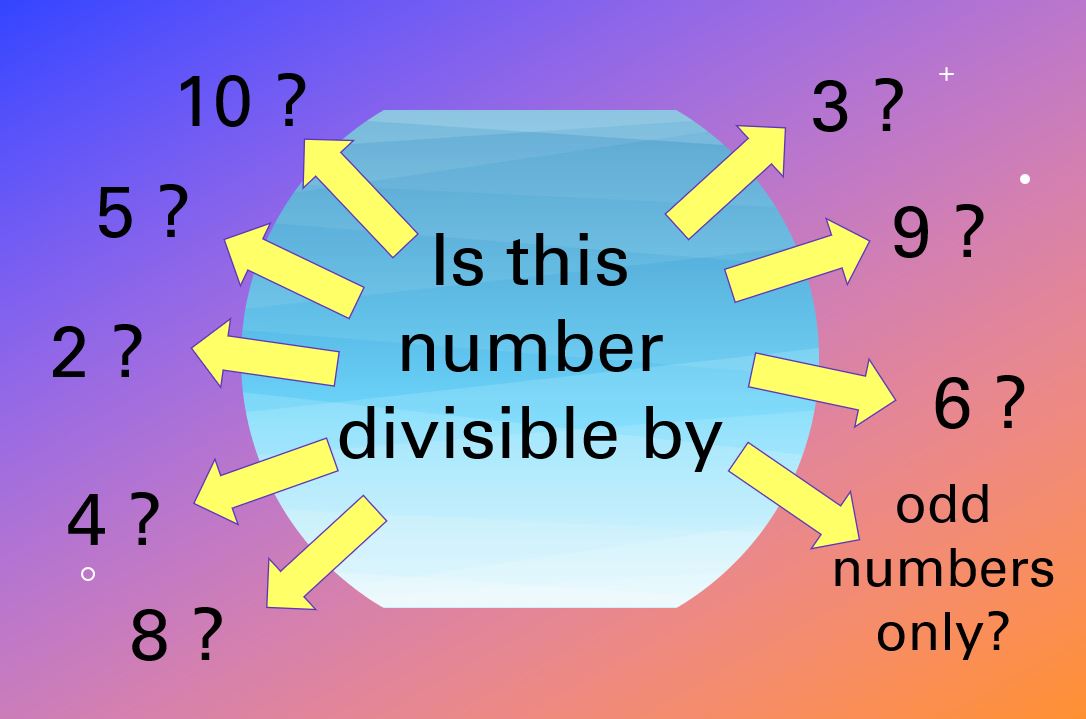
How to apply the Rules of Divisibility
Can you tell, just by looking at the number 31845, whether it can be divided by 5 without leaving a remainder?
How about rules of divisibility for 3 or 9 or 15: will there be a remainder if you divide 31845 by each of those?
Rules of divisibility aren’t explicitly mentioned on the GCSE specification, but often it’s useful to be able to quickly decide whether you can divide a large number by a much smaller one without leaving a remainder – for example when you’re cancelling down to simplify a fraction.
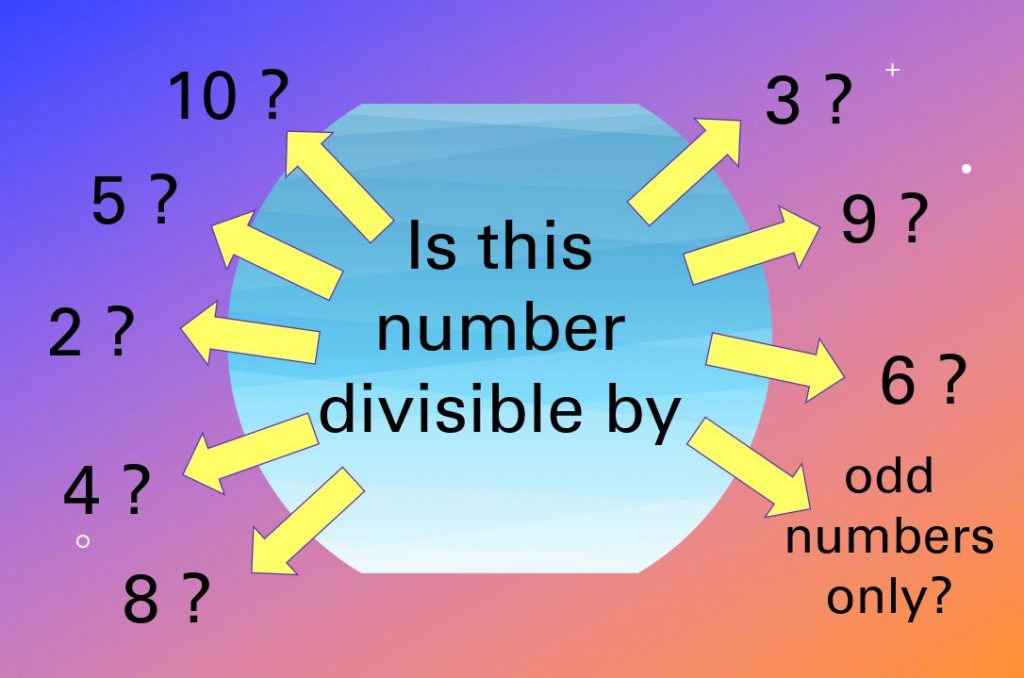
What is divisibility?
If you can divide the larger number by the smaller one without leaving a remainder then we say that the larger one is a multiple of the smaller, or divisible by the smaller.
(You shouldn’t really just ask “Can I divide A by B?” because there’s nothing to prevent you from dividing any pair of numbers; you just might get a remainder or a decimal result.
For example 7 ÷ 3 = 2⅓, or 2 remainder 1, or 2.3333…
… so you CAN divide 7 by 3, but 7 isn’t divisible by, or a multiple of, 3, because you’re left with a remainder.)
Let’s start with the easiest rules of divisibility, which you might already know: those for 10, 5, and 2.
Is this number divisible by 10?
Any multiple of 10 will end in a zero (and only multiples of 10 do), so if a number ends in zero then it’s divisible by 10.
Of course, a number ending in 00 means a multiple of 100; ending in 000 means a multiple of 1000, and so on.
Is this number divisible by 5?
Any number ending in either 5 or 0 is in the 5 times table, so if a number ends in 5 or 0 then it’s divisible by 5.
Is this number divisible by 2?
Any even number is a multiple of 2, so if a number ends in 0, 2, 4, 6 or 8 then it’s divisble by 2.
Does this number have any even factors?
In fact any multiple of any even number is even – you only get an odd product when you multiply only odd numbers together. (Try a few examples if you like!) So any odd number is only divisible by other odd numbers.
For example, 4539 is an odd number so it must only have odd factors; it’s not divisible by any even numbers.
Your turn 1
Look at this list of numbers and think about their divisibility: which of them are divisible by 10? 5? 2? only odd numbers?
- 132
- 360
- 547
- 648
- 2345
- 6370
- 9236
- 31845
Now let’s have a look at some less well-known rules of divisibility.
Is this number divisible by 3?
This is a handy piece of information that you might not have come across before: if the sum of the digits of of any whole number is a multiple of 3 then the number itself is also a multiple of 3.
For example, consider 8192:
8 + 1 + 9 + 2 = 20; 20 isn’t in the 3 times table so 8192 is not a multiple of 3.
But if we add 1 onto any of the digits, to give for example 8193 or 8292, then sum of the digits is 21. That is a multiple of 3, so 8193 and 8292 are both divisible by 3 too.
Try dividing 8192, 8193 and 8292 by 3 (using bus stop division or your calculator) and you’ll see!
Is this number divisible by 9?
The same approach works for identifying multiples of 9… except that in this case the sum of the digits needs to be a multiple of 9.
Looking at 8192 again, the sum of digits is still 20, which isn’t a multiple of 9, so 8192 isn’t a multiple of 9 either.
But if we subtract 2 from any of the digits then the sum will be 18, which is a multiple of 9. For example 8190 would work, and so would 8172 or 6192.
Is this number divisible by 4?
100 is a multiple of 4, so once you get past 100, the next few multiples of 4 are 104, 108, 112, 116, and so on…
… so you could drop the 1 at the beginning and they’d all still be multiples of 4…
… so the last two digits of a number are all you need to look at to identify whether a number is divisible by 4.
If the last two digits are a multiple of 4 then the entire number is a multiple of 4.
Your turn 2
Here’s the same list of numbers again. Can you use the rules of divisibility to identify which of them are divisible by 3, 9 and 4?
- 132
- 360
- 547
- 648
- 2345
- 6370
- 9236
- 31845
We can extend this to cover other numbers by combining the rules of divisibility.
Is this number divisible by 6?
The prime factors of 6 are 2 and 3, so if you can divide a number by both 2 and 3 – in other words if it’s an even multiple of 3 – then it’s divisible by 6.
In fact you can use this approach for any number that has unique factors that you have rules for (with no overlap between the prime factors involved).
For example, 15 has prime factors 3 x 5, so if a number is divisible by both 3 and 5 then it’s also divisible by 15.
12 = 3 x 4, so if a number is divisible by both 3 and 4 then it’s also divisible by 12. In other words, every 4th multiple of 3 (or every 3rd multiple of 4) is a multiple of 12.
Since we have a rule for identifying multiples of 3 and one for identifying multiples of 4, we can use both of those rules. If they both apply then we know that we have a multiple of 12.
We can use a similar approach to identify numbers divisible by 18, since 18 = 2 x 9 and we have rules for both of those factors too.
Is this number divisible by 8?
This one’s a bit trickier, because although 8 = 2 x 4 and we have rules for both 2 and 4, the prime factor of 2 is repeated in the 4, so the rules can’t be applied independently. This is what was meant by “no overlap” in the previous section.
Instead you can use this (slightly unwieldy) rule for 8:
If half of the number is a multiple of 4 then the number is divisible by 8.
This works because 8 = 2 x 4 so dividing a multiple of 8 by 2 will always give a multiple of 4.
In algebraic terms, 8n = 2 x 4n (where n is any whole number) so 8n ÷ 2 = 4n, which must be a multiple of 4.
Your turn 3
A final look at the list of numbers. Use the rules of divisibility to decide whether each of them is divisible by 6, 8, 12, 15 and 18.
- 132
- 360
- 547
- 648
- 2345
- 6370
- 9236
- 31845
🤞 Rules of divisibility – key points:
A number is divisible by:
10 – if it ends in 0
5 – if it ends in 5 or 0
2 – if it’s even, i.e. ends in 0, 2, 4, 6 or 8
An odd number is divisible ONLY by odd numbers
A number is divisible by:
3 – if the sum of its digits is a multiple of 3
9 – if the sum of its digits is a multiple of 9
4 – if its last two digits are a multiple of 4
A number is divisible by:
8 – if HALF of it is divisible by 4
6 – if it’s divisible by both 2 and 3
12 – if it’s divisible by both 3 and 4
15 – if it’s divisible by both 3 and 5
18 – if it’s divisible by both 2 and 9

If you’ve found this article helpful then please share it with anyone else who you think would benefit (use the social sharing buttons if you like). If you have any suggestions for improvement or other topics that you’d like to see covered, then please comment below or drop me a line using my contact form.
On my sister site at at mathscourses.co.uk you can find – among other things – a great-value suite of courses covering the entire GCSE (and Edexcel IGCSE) Foundation content, and the “Flying Start to A-level Maths” course for those who want to get top grades at GCSE and hit the ground running at A-level – please take a look!
If you’d like to be kept up to date with my new content then please sign up to my mailing list using the form at the bottom of this page, which will also give you access to my collection of free downloads.
If you’ve found this article helpful then please share it with anyone else who you think would benefit (use the social sharing buttons if you like). If you have any suggestions for improvement or other topics that you’d like to see covered, then please comment below or drop me a line using my contact form.
On my sister site at at mathscourses.co.uk you can find – among other things – a great-value suite of courses covering the entire GCSE (and Edexcel IGCSE) Foundation content, and the “Flying Start to A-level Maths” course for those who want to get top grades at GCSE and hit the ground running at A-level – please take a look!
If you’d like to be kept up to date with my new content then please sign up to my mailing list using the “Subscribe here” form at the bottom of this page, which will also give you access to my collection of free downloads.
Answers









One Comment