
How I check a new GCSE student’s basic skills
Basic skills check
When I take on a new 1-to-1 tutee for GCSE Maths, the first thing I ask them to do is a basic skills check. They shouldn’t view this as a test; they can look things up and take their time, doing it over two or three short sessions if they choose. The aim is to identify any gaps in the basic skills that they should have covered in Maths before the end of KS3; a lot of it will have been covered in primary school. Most of it should be fairly straightforward, but even with a very able student I can usually show them one or two things they didn’t already know.
Basic skills that they are asked to demonstrate – including showing valid methods of working, and without using a calculator – are:
- Addition, subtraction, multiplication and division (including long multiplication and long division)
- Using place value to sort positive and negative numbers into order
- Rounding to a specified degree of accuracy (nearest 10, nearest tenth, 2 decimal places, 3 significant figures)
- Order of operations (BIDMAS – or GEMA if you prefer) to evaluate an expression
- Fractions: finding a fraction of an amount, working with equivalent fractions, arithmetic with fractions
- Finding simple percentages of amounts
- Multiplying and dividing with decimals
- Solving simple equations
You may think that some of these skills are of little use in the real world. Even so, they are still examined at GCSE… and some of the techniques – for example arithmetic with fractions – will be needed if the student goes on to study Maths at a higher level. It’s surprising how many students starting the A-level Maths course can’t remember how to add two fractions with different denominators!
In our first lesson we’ll go through the exercise – which ideally they’ll already have worked through beforehand (I like to give full value for money!) – and identify the gaps in their basic skills that it reveals. Some of these gaps can be addressed in just a couple of minutes; others will take longer.
Prioritising topics
We’ll also discuss any areas of the GCSE course that they feel need particular attention, either because they have struggled with the material or because they have missed out on teaching, perhaps due to illness or a change of teaching set.
As an example, here’s the list of topics that I use as a prompt for Foundation GCSE students:
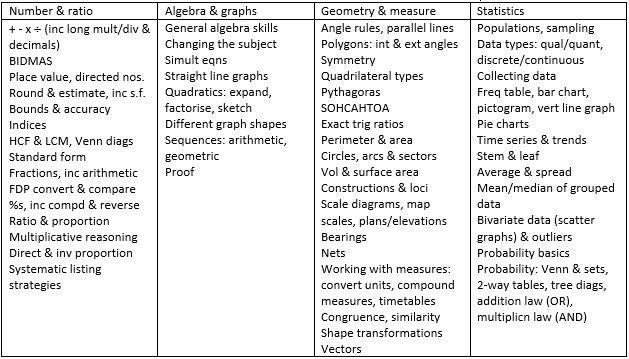
We will of course aim to cover as many of the topics in the relevant exam specification as time permits, but this initial discussion allows me to plan for that particular student’s immediate needs.
From that initial discussion I’ll draw up a provisional plan for a few weeks at a time, listing topics and providing directions to sources of further practice for homework or voluntary independent study. (Corbettmaths is a favourite for this.) The plan is always flexible, so if the student wants to go “off-piste” and spend time looking at something they’ve been struggling with at school that week then I’ll accommodate that (though not to the extent of doing their homework for them!). I generally update a student’s plan roughly once every 6 weeks or so.
If I’m asked to try to coordinate with the school’s scheme of work then I’m happy to do so if the student/parent can provide me with with the necessary information on what skills will be covered when. However, it’s generally better to NOT be in sync, because interleaving topics – revisiting one topic while studying others – helps with memory.
Maths should make sense, and a good tutor can be a great help here. If the basics don’t make sense to the learner then what hope do they have of getting to grips with the harder material in the exam specification?
To find out more about my tuition services, take a look at my Maths Help page. You can sign up there to access some useful free resources, and also see what other services I have to offer.

If you’ve found this article helpful then please share it with anyone else who you think would benefit (use the social sharing buttons if you like). If you have any suggestions for improvement or other topics that you’d like to see covered, then please comment below or drop me a line using my contact form.
On my sister site at at mathscourses.co.uk you can find – among other things – a great-value suite of courses covering the entire GCSE (and Edexcel IGCSE) Foundation content, and the “Flying Start to A-level Maths” course for those who want to get top grades at GCSE and hit the ground running at A-level – please take a look!
If you’d like to be kept up to date with my new content then please sign up to my mailing list using the “Subscribe here” form at the bottom of this page, which will also give you access to my collection of free downloads.


