
Avoid overwhelm in your Maths revision
As I write this at the end of February, we’re moving into the pre-exam revision period. There’s no getting away from the fact that there’s a lot of content in GCSE Maths, but you can reduce it into smaller parts so that it’s less overwhelming. This is often referred to as “chunking”.
What is chunking?
Chunking is about splitting a large task into smaller, more manageable, bite-sized pieces so that your brain doesn’t suffer from overwhelm by having too much thrown as it at once. When you’re first learning a Maths topic it might mean breaking a task right down into its smallest building blocks: for example, when learning to add fractions you need to pass through several stages:
- Adding fractions with the same denominator: Understand that the denominator is a kind of unit – it tells you how big each piece is – and that if all your units are the same size (all fifths, or all eighths, etc.) then you can just add them up by adding the numerators.
So 1 eighth plus another 5 eighths
- Turning fractions into equivalent fractions – needed so that you can add fractions with different denominators.
- Adding fractions with different denominators: First, choose a denominator that you can put them both into. Then use your equivalent-fraction skills to do that. (Usually you’ll start with examples where only one fraction needs to be converted, and move on to harder ones once you’ve got that sussed.) Then you just add up the numerators, as before.
Then of course you also have improper fractions and mixed numbers to deal with, so that also needs to be covered before you can combine it with the adding process.
Chunking and revision
At this stage of Year 11 you should have those basic steps pretty much sorted for most topics. If you still need to check back on a technique every now and then then that’s not a problem; you just need to gradually build up your independence over the next few weeks.
As we go into the spring you need to be working through exam-style questions. Rather than jumping straight in and tackling whole papers, which can be overwhelming, I suggest you start by making a list of topics that you feel you need to work on – Maths Genie is a great resource for this. If you go into the Revision section for the qualification that you’re working towards (e.g. GCSE Maths, IGCSE Maths) then the topics are listed by grade. Of course, there’s really no such thing as as “Grade 6 question”, but these classifications are useful as a rough guide to the level of difficulty that’s expected at your target grade.
Start a couple of grades below the level you’re aiming for, and make a note of the topics that you feel less confident with. Also have a quick scan through the lower grades in case there’s anything there that you feel you need to go over. Move up a grade and repeat, and again until you get to your target grade. If there are any topics above that grade that you feel able to tackle then by all means add those too, but keep it manageable – it might be better to come back and do that once you’ve built up your confidence at the lower grades.
Try to set aside a particular time slot to work on each subject. If you can manage half an hour of Maths every day then that’s great. Little and often is usually the best way to do it.
Choose a topic to work on in each session – set up a schedule if you can – and use that time to work through questions on that topic. Set a timer for maybe 15-20 minutes and see how much you can do in that time – but focus on getting it right, not on speed! If you get stuck on one question then just go on to the next one; if you’re still struggling after two or three questions then go back and look at your notes, check the text book or watch a video. When the time is up, mark your answers and make a note of any areas you need to improve on.
My Grade 4 Essentials course contains videos that will help you with all of the Foundation content for both GCSE and the Edexcel IGCSE, and the FSALM course covers the majority of the Higher content. And of course Corbettmaths has a wealth of material too.
Don’t forget to interleave your study – that means adding in short reviews of topics you’ve already looked at. You could set aside the first or last 5-10 minutes of each slot for that, or use one session a week to just review the week’s topics by doing a couple more questions on each one. Or even both!
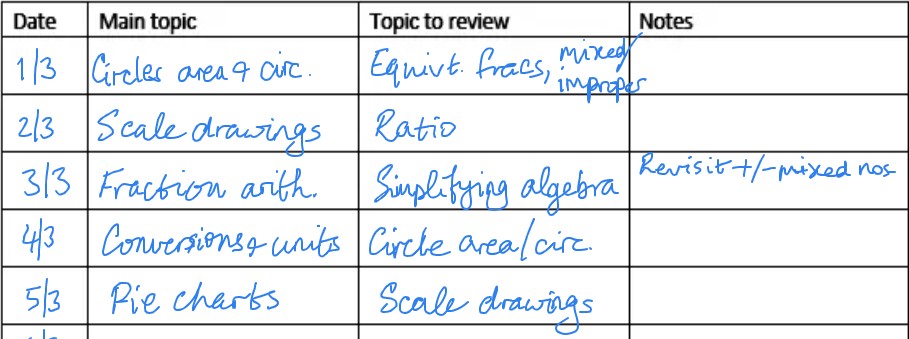
Your plan might look something like this – but of course you’ll probably need more time on some topics and less on others, so some flexibility will be needed.
It’s also helpful if you can learn how to interpret a mark scheme, so you can see if you’ve missed anything important out of your answer, or if you’d have got some method marks even though you might not have got the right answer.
(Now that’s an idea for a future blog post!)
Another excellent source of GCSE past exam questions collated by topic (but without the grade descriptors) is GCSE Maths Questions. The collections are in the form of PowerPoint files, which you can view online in slideshow mode, and include model solutions.
What if I just freeze when I have an exam question in front of me?
Try to relax, maybe do some breathing exercises if you feel overwhelmed and panicky. For example try box breathing: In for a count of 4, hold for 4, out for 4, count 4 before inhaling again. Or count slowly to 30 while imagining yourself in your happy place, wherever that may be.
When you’re feeling a little calmer, re-read the question and ask yourself (a) what result is it asking for, and (b) what CAN I do with the information I’ve been given? Even if you can’t work out what it wants, more often than not there’ll be marks to be had for just taking one step in the right direction, and if you’re lucky then that will lead you to the next stage and maybe even the final answer.
If you have model solutions or a video walkthrough then take a peek if you need to, but try to only reveal one step at a time and see if you can get a bit further on your own before peeking again.
As the exams get closer…
By about late March / early April you should be working through whole exam papers – not necessarily doing a whole paper at one sitting, but working through one over maybe three or four sessions.
If you’re doing Higher GCSE and aiming for Grade 6 then bear in mind that roughly half the marks on the paper are targeted at students aiming for Grades 7-9, so try not to feel discouraged or overwhelmed if it feels as if there’s still a lot you can’t do. Focus on the first half of the paper; don’t completely ignore the rest, but think of any marks you can pick up there there as a bonus! Sometimes it’s quite easy to get the first mark even on a very challenging question, so remember to ask yourself: What CAN I do with the information they’ve given me?
The good news is that with actual past papers it’s usually easy to find online walkthroughs that explain how to approach each question, so there’s plenty of free help out there if you get stuck. Maths Genie has them for the Edexcel GCSE papers but for the other boards and IGCSE you’ll need to look elsewhere – try Mr Tompkins Edtech on YouTube for GCSE (AQA/Edexcel/OCR) and The Math Pad for IGCSE (4MA1 is the Edexcel exam, and 0580 is the Cambridge one).
As the exams get closer, build up to doing papers under exam conditions, even if it’s still with a single paper split over several sessions. Once you’ve finished a paper (or, if you prefer, a half-hour stint), check your answers, and before you go on to the next paper, revisit any topics that you’re still not quite sure of.
Use this chunking approach to gradually build your confidence, and you should find your exam prep much less overwhelming.
Take a look at my other blog posts for more Maths revision tips, and for advice on exam technique to avoid losing marks unnecessarily.

If you’ve found this article helpful then please share it with anyone else who you think would benefit (use the social sharing buttons if you like). If you have any suggestions for improvement or other topics that you’d like to see covered, then please comment below or drop me a line using my contact form.
On my sister site at at mathscourses.co.uk you can find – among other things – a great-value suite of courses covering the entire GCSE (and Edexcel IGCSE) Foundation content, and the “Flying Start to A-level Maths” course for those who want to get top grades at GCSE and hit the ground running at A-level – please take a look!
If you’d like to be kept up to date with my new content then please sign up to my mailing list using the “Subscribe here” form at the bottom of this page, which will also give you access to my collection of free downloads.