How to interpret a Maths mark scheme – Part 2
This article follows on from Part 1, which gives a general introduction to mark schemes. In this part we’re going to look at some actual example questions and mark schemes, from three different exam boards, to help you understand how the marks are awarded.
Example questions and mark schemes
The following questions are all taken from Foundation papers to make them accessible to as many students as possible, although the same principles apply at higher levels including A-level.. Don’t just look at the examples for your own exam board; the mark schemes and marking criteria are similar enough that they should all be helpful.
I’ve mostly avoided 1-mark questions as those are usually just a matter of getting the right answer; either you get it right, in which case you get the mark, or you don’t. Of course some 1-mark questions require an appropriate comment – such as a reason why something is wrong – so those are trickier to judge, but mark schemes often provide several examples of answers that are and are not acceptable. B1 or (on Edexcel) C1 against an answer indicates that it would get the mark; examples shown with B0 or C0 would not.
Edexcel question 1
Part (a) is worth 2 marks and part (b) is worth 1.
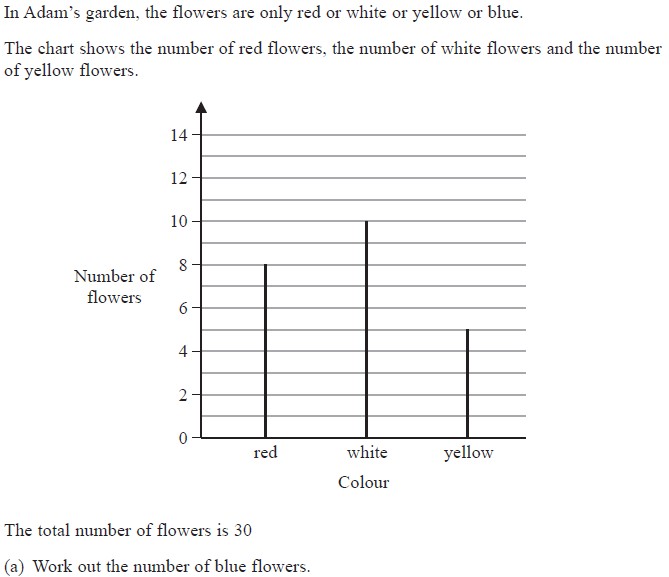

What you’re expected to do for part (a) is read off the number of red, white and yellow flowers – 8, 10 and 5 respectively, which add up to 23 – and take the total away from 30 to work out how many are blue: 30 – 23 = 7.
For part (b), you should know that the mode is the colour that there are most of, i.e. white.
(If a question says “Write down” then that’s a hint that you shouldn’t need to do any calculation to find the answer.)
Here’s the mark scheme (unfortunately the text is rather small because Edexcel GCSE mark schemes are in landscape format, but you may be able to right-click and open the image in a new tab/window to enlarge it):

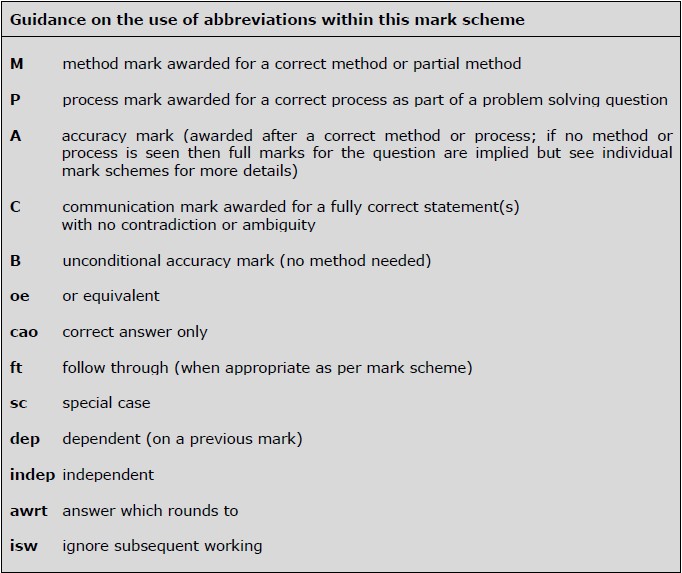
There’s a process mark (this would be a method mark on AQA or OCR) for taking the right steps to work out the number of blue flowers. One mistake is permitted – so for example you could misread yellow as 6 and still get the mark. Then there’s an accuracy mark if you end up with an answer of 7. The “cao” (correct answer only) means that no other answer is acceptable.
For part (b), note the “ft”. That means that if you’d somehow ended up with more blues that whites in part (a) then your answer to (b) should be blue, following through from your previous answer.
Edexcel question 2
This is a 4-mark question and can be approached in several different ways.
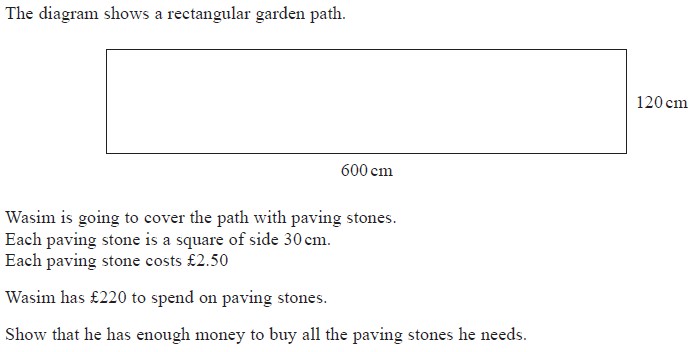
First we need to work out how many paving stones will fit into the area. Probably the simplest way to do this is to work out how many 30cm stones will fit along each side: stones long
 stones wide
 stones needed in total
Now we can work out the total cost:
Finally state the conclusion:
Wasim has £20 more than he needs to buy the stones.
Mark scheme:
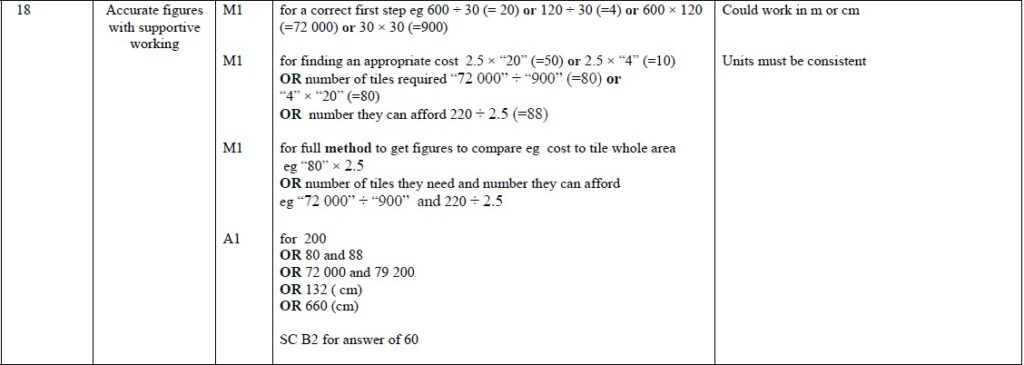
The first M mark is for a correct first step: working out how many paving stones (or tiles, as the mark scheme describes them!) will fit along one side of the path, or working out the area of either the path or a single slab. It doesn’t matter whether you use metres or cm, as long as you choose one and stick to it.
The second M mark is for working out the total number of stones required, or the cost of stones along one edge, or how many can be bought with the available money. Note the use of “20” and other numbers in quotation marks; if you’ve previously worked out  but got an answer of 15 instead of 20, then used
  at this stage, then you’ll still get the method mark.
The third M mark is for completing the method so that you end up with two figures you can compare. These could be the total cost vs the money available, or how many stones you can afford versus how many are needed.
The final accuracy mark is for arriving at correct values that allow you to make a comparison. In this particular question they’re not demanding a concluding statement (such as “He has more money than he needs”) but it’s usually required on “show that” questions like this, so you should always write one down.
The mark scheme also shows an SC B2 at the bottom; that means that if the candidate gets an answer of 60 then it’s a special case that gets them two B marks. The reason for this isn’t jumping out at me but the senior examiners must have given it due consideration!
Edexcel question 3
Another 4-mark question.
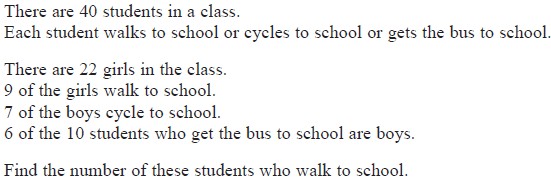
Here we need to put together a breakdown of means of travel for both boys and girls in the class. You might choose to do this using either a tree diagram or, as shown on the mark scheme below, a 2-way table.
Thinking it through:
If there are 40 people in total and 22 are girls then the number of boys must be 40 – 22 = 18.
So we know that of the 18 boys, 7 cycle to school and 6 take the bus, making a total of 13. That leaves 5 who must walk to school.
We were told in the question that 9 girls walk to school so we already have all the information we need to give the answer: The number of children who walk to school is 14 (consisting of 9 girls and 5 boys).
(Of course, you could complete the whole tree/table as follows:
If 10 people take the bus and 6 of them are boys then the number of girls who take the bus must be 10 – 6 = 4.
So out of 22 girls we have 9 who walk and 4 who take the bus, leaving 9 who must cycle.)
Mark scheme:
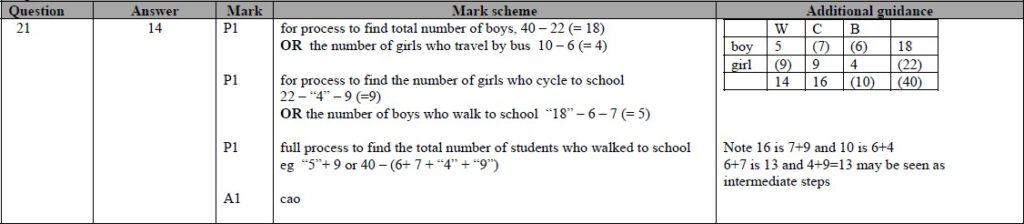
The additional guidance in the mark scheme’s right-hand column shows the information as a 2-way table, with the values provided in the question shown in brackets. A table like this isn’t necessary to get the marks, but it (or a tree) is a sensible way to lay out the information.
The first process mark (again, these would be method marks on AQA or OCR) was for using a correct method to work out either the number of boys, or the number of girls who took the bus. (Even though the latter of these wasn’t actually necessary to answer the question, it was a sensible step in building up the full picture, and used the same skill as the former.)
If you just wrote “18 boys” without any working then that would get you this mark, as it’s a correct answer with no evidence of a wrong method. However, just writing an incorrect value such as “16 boys” without showing how you’d got there, would NOT get you the mark; a wrong answer with no method behind it gets no credit. You would still get the mark if you’d first written “40 – 22” (or “10 – 6” for the other accepted calculation), though. So it’s always worth writing down your working – remember that the examiner can’t read your mind!
The second process mark was for a correct method to work out how many people used the third mode of transport among either the girls (cycling – not actually needed) or the boys (walking – necessary to answer the question). So for the boys you needed to subtract the 7 cyclists and the 6 bus-takers from the total number of boys.
The “18” in quotation marks means that if you’d got the wrong number of boys then as long as you made it clear that you were subtracting from your total number of boys, you’d still get this mark. This mark isn’t dependent on the previous P mark (otherwise it would be shown as “P1 dep”) so you could still get it even if you didn’t get the previous mark.
The third P mark is for completing the process of working out the total number of walkers: finding the number of boys, then the number of boys who walked, and adding that to the number of girls who walked.
And the final A mark is for getting the right answer.
AQA Question 1
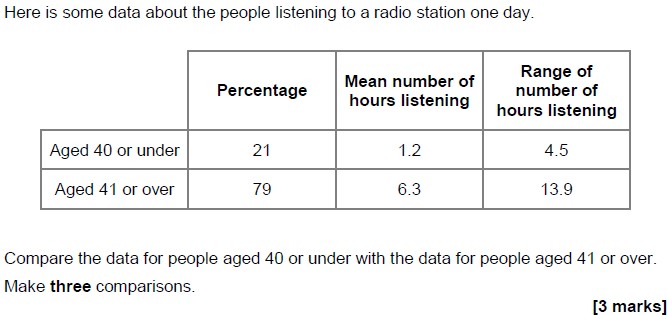
It’s often hard to know what the examiner is looking for in questions like this. The table contains comparisons between two different age ranges for three different pieces of information, and three comparisons are required, so you need one relating to the percentage (or proportion) of each age group, one relating to the mean number of hours listening, and one relating to the range.
This is a good general rule for comparing data sets: they usually want one comment comparing the average (mean, median or mode) and one comparing the spread (usually the range at GCSE Foundation level, but at Higher it could be the interquartile range and for other exams the variance or standard deviation). Also don’t forget to put the data in context, i.e. explain what the numbers actually mean. For example, “The 40 and unders are 21% and the older people are 79%” doesn’t tell us as much as “21% of the listeners are 40 or under, and 79% are older”.
The mark scheme for this one includes a lot of additional guidance to help you understand what is and is not an acceptable answer. First, here’s the actual mark scheme, with suggested answers that would be acceptable and some general guidance:
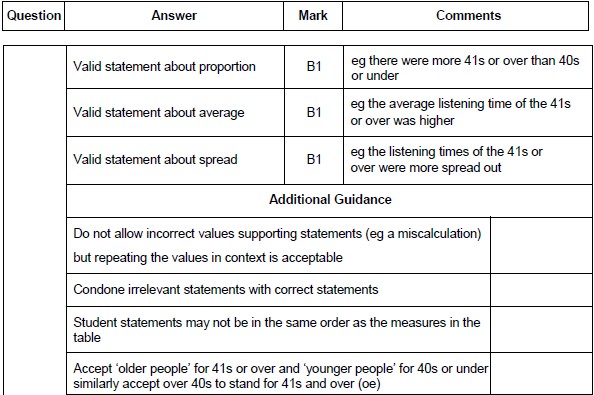
If you make two comments about the same piece of information (e.g. “Only 21% of listeners are 40 or under” and “The majority of listeners are 41 or older”) then that will only get you a single mark. In fact the first of these statements on its own doesn’t actually compare the proportions so it wouldn’t have got a mark anyway.
“Condone” means “It’s not really right, but don’t penalise them for it”, so “Condone irrelevant statements with correct statements” means that as long as you said something that was acceptable and didn’t contradict yourself, it wouldn’t matter if you added something irrelevant such as suggesting a possible reason for the difference between the age groups.
Then we get lots of examples of acceptable (B1) and unacceptable (B0) answers for each mark:
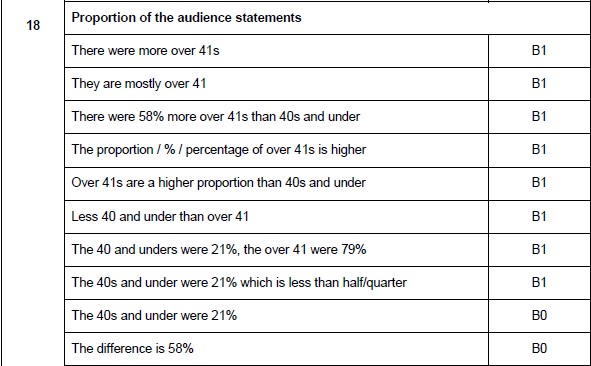
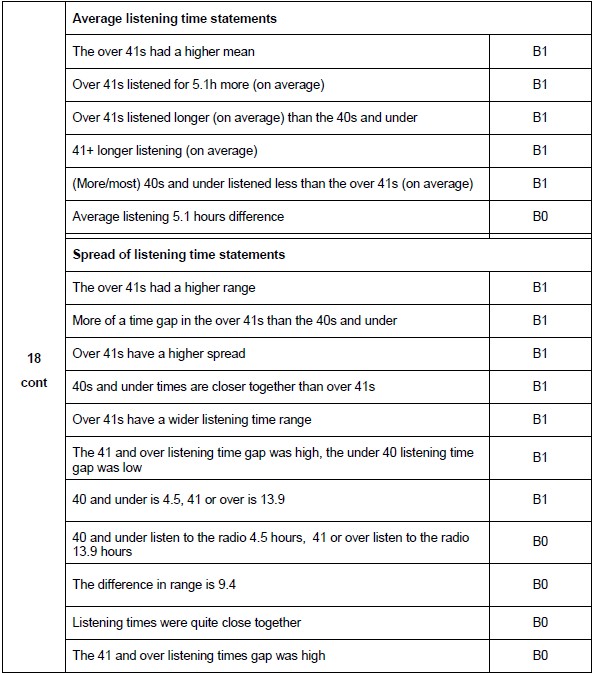
Looking at the examples above, you can see that the mark is lost if:
- you only state one value and don’t compare it with the other
- you say what the difference is, but not which one is bigger/smaller
Sometimes you might lose the mark if you fail to give context, e.g. rather than just saying “Over 41s have a wider range”, it’s better to say “Over 41s have a wider range of listening times”. That doesn’t seem to have been a strict requirement for this particular question, but sometimes it is.
AQA Question 2

This one is intended to test the candidate’s skill with the laws of indices.
The most efficient way to approach it is probably:
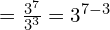
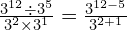 [subtract indices to divide and add them to multiply]


Mark scheme:
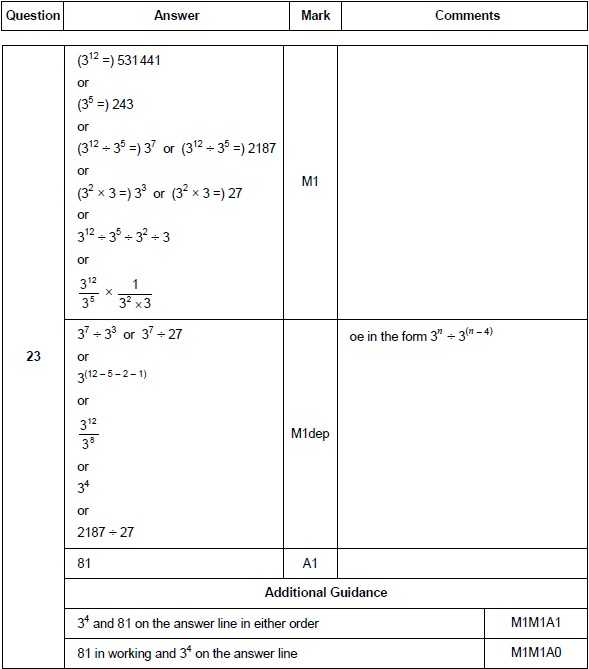
The first M (method) mark is for either applying (correctly) one of the laws of indices, or demonstrating that you know the meaning of  or similar. (Just stating that
  wouldn’t be enough though!)
The second M mark is shown as M1dep, which means that it’s only possible to get that one if you’ve already earned the first one. This mark is for getting to an expression that’s just one step short of  .
.
For the final mark you need to correctly convert the into an ordinary number, i.e. 81, and give that as your answer.
OCR Question 1
This is a 4-mark question and is from a calculator paper.
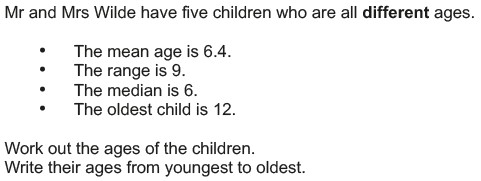
I suggest starting this one by listing the ages from youngest to oldest as a, b, c, d, e.
The median is 6 so that’s the middle one, c. The oldest is 12 so that’s e.
So now we have a, b, 6, d, 12.
The range is 9 so the youngest must be 9 years younger than the older, so a is 3:
3, b, 6, d, 12.
Now the tricky bit:
The mean age is 6.4 so that tells us that {sum of all ages} 
So the sum of all their ages must be 6.4 x 5 = 32.
Take away the 3, the 6 and the 12 and we’re left with b + d = 11.
We know that b has to be between 3 and 6, and d is between 6 and 12.
b can’t be 5 because then d would only be 6, and we’ve been told that all the ages are different.
However, b = 4 and d = 7 works.
So we end up with 3, 4, 6, 7, 12.
Mark scheme:

OCR sets its mark schemes out a little differently, but the information and marking criteria are still similar.
In this case you get a B (independent) mark for putting either the 6 or the 12 in the right place, and a second B mark for getting 3 for the youngest child.
Then there’s a method mark for finding the sum of all the ages and taking away the the three you know. “soi” means “seen or implied” – this is saying that if you don’t actually show the calculation of 6.4 x 5 and then subtracting 3, 6, and 12, you can still get the mark if you’ve clearly ended up with 11, or 3 and 8, or 4 and 7, or 5 and 6, since that implies that you’ve followed the right method.
But of course you need the 4 and 7 to get the final mark.
OCR Question 2
Another calculator question, this one worth 3 marks.
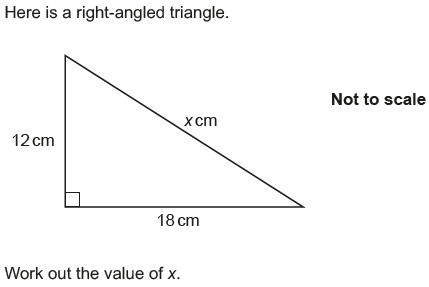
The usual way to answer this would be to use Pythagoras’ Theorem:
 cm
cm
Mark scheme:

There was a method mark for adding  and
and  and a second method mark for finding the square root of the answer (again we have the “seen or implied by
  “: if you’ve got as far as then that’s enough to convince the examiner that you used a valid method to get there). The third mark was for ending up with the correct answer of 21.6 or 21.63…
The  is another way of writing , and so is also correct (it’s a surd in its simplest form) and would be awarded full marks, although simplifying surds isn’t on the Foundation spec.
The “See appendix” refers to this section at the end of the mark scheme which shows two possible alternative methods for answering the question using SOHCAHTOA:
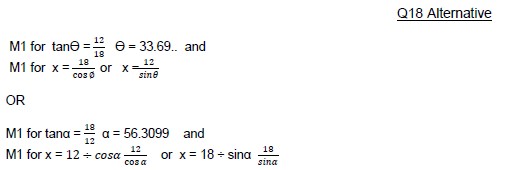
Although not many people would choose to use these approaches, they are correct and so would still get the marks. This breakdown shows what’s required for each method mark if a candidate uses either of these methods, and of course the final mark is still awarded for the correct answer.
So that concludes this guide to interpreting mark schemes for GCSE Maths (and other Maths exams). I hope you’ve found it helpful and you now feel a bit more confident about marking your own answers to exam questions!

If you’ve found this article helpful then please share it with anyone else who you think would benefit (use the social sharing buttons if you like). If you have any suggestions for improvement or other topics that you’d like to see covered, then please comment below or drop me a line using my contact form.
On my sister site at at mathscourses.co.uk you can find – among other things – a great-value suite of courses covering the entire GCSE (and Edexcel IGCSE) Foundation content, and the “Flying Start to A-level Maths” course for those who want to get top grades at GCSE and hit the ground running at A-level – please take a look!
If you’d like to be kept up to date with my new content then please sign up to my mailing list using the “Subscribe here” form at the bottom of this page, which will also give you access to my collection of free downloads.


